Neil Tuckwell·Science writer covering the biology of aging. Turns cutting-edge anti-aging research into stories you'll want to read over morning coffee.··7 min read
A Beginner's Guide to NMN Supplements
What if you could top up one of the molecules your cells need most — and that your body makes less of every year? That is the promise behind nicotinamide mononucleotide (NMN), a supplement that has gone from obscure lab compound to one of the most talked-about longevity molecules in the world. This guide walks you through what NMN actually does, what clinical trials show, and how to decide if it belongs in your routine.
What Is NMN and Why Does It Matter?
NMN is a naturally occurring molecule and a direct building block of nicotinamide adenine dinucleotide (NAD+), a coenzyme found in every cell of your body. NAD+ powers hundreds of critical processes — from converting food into energy to repairing damaged DNA. The problem is that NAD+ levels decline steadily as you age, and that decline is linked to everything from fatigue to metabolic slowdown[1][5].
NMN is converted directly into NAD+ inside your cells, bypassing the usual bottleneck in NAD+ production.
Think of NAD+ as your cell's rechargeable battery. When you are young, the battery stays charged. As you age, the charger slows down. NMN works by skipping the slowest step in that charging process — the enzyme NAMPT — and feeding your cells a molecule that converts almost immediately into NAD+[1]. Oral NMN at doses from 250 to 900 mg per day reliably raises blood NAD+ levels in humans within 30 to 60 days[1][2][5].
In September 2025, the FDA confirmed that NMN is lawful as a dietary supplement, ending years of regulatory uncertainty. Companies must still submit premarket notifications, but the supplement is no longer in legal limbo.
Who Might Benefit from NMN?
The short answer: anyone whose NAD+ levels have started to decline — which, based on current research, means most adults over 40. But the evidence points to a few groups that may benefit most.
Frequently Asked Questions
This content is for informational purposes only and is not intended as medical advice, diagnosis, or treatment. Always consult a qualified healthcare provider before starting any supplement or making changes to your health regimen.
NT
Neil Tuckwell
Science writer covering the biology of aging. Turns cutting-edge anti-aging research into stories you'll want to read over morning coffee.
Science writer covering the biology of aging. Turns cutting-edge anti-aging research into stories you'll want to read over morning coffee.
NMNNAD+longevityanti-aging supplements
Related Articles
Longevity Science
3-Minute Guide: Rapamycin + Trametinib -- The Combination That Extended Mouse Lifespan 29%
A 2025 Nature Aging study found rapamycin and trametinib together extended mouse lifespan 29%. Here's the science behind this longevity combination.
Neil Tuckwell·4 min read
NAD+ levels drop with age, affecting energy production, DNA repair, and cellular maintenance.
A meta-analysis of 9 randomized controlled trials (RCTs) with 412 participants found that NMN significantly improved gait speed in middle-aged and older adults[7]. A separate 12-week trial in 60 older adults showed that just 250 mg per day maintained walking speed and improved sleep quality compared to placebo[4]. These are not dramatic gym-performance gains — they are the kind of everyday functional improvements that matter when you want to stay active as you age.
The research also suggests that people with early metabolic concerns may see benefits. In a dose-response trial of 80 adults aged 40 to 65, the NMN groups maintained stable biological age markers while the placebo group's markers worsened over 60 days[1]. That said, a systematic review of 12 RCTs with 513 participants found that NMN did not significantly improve fasting glucose, triglycerides, or cholesterol[2]. The metabolic story is still incomplete.
What Does the Research Say?
Let's look at the numbers. Across multiple human trials, one finding is remarkably consistent: NMN raises blood NAD+ levels. A 2025 meta-analysis pooling 12 RCTs confirmed significant NAD+ elevation across all studied doses[2]. That part of the science is solid.
Multiple clinical trials confirm that NMN reliably raises NAD+ levels — but downstream health effects vary.
The downstream effects — the outcomes you actually care about — are more nuanced. Here is what the best available evidence shows:
Walking speed: A meta-analysis of 9 RCTs found a significant improvement in gait speed (standardized mean difference of 0.34, p = 0.033) among middle-aged and elderly participants[7].
Walking endurance: In a multicenter trial of 80 adults, the 600 mg per day group showed significantly improved walking distance compared to placebo[1].
Sleep quality: A 12-week trial found that 250 mg per day significantly improved sleep scores and reduced daytime dysfunction in older adults[4].
Quality of life: SF-36 scores improved significantly across NMN groups in a dose-response study[1].
Glucose and lipid metabolism: Not significantly different from placebo across 12 RCTs — a finding that tempers some of the bolder marketing claims[2].
One important caveat: individual responses vary enormously. A post-hoc analysis found that NAD+ elevation varied with a coefficient of variation as high as 113% between people taking the same dose[8]. Your response to NMN may look very different from someone else's.
Side Effects and Safety
Here is where NMN stands out from many supplements: its safety profile across human trials is remarkably clean. A systematic review of 10 RCTs involving 437 participants reported zero serious adverse events[3]. No study found any side effect that was determined to be caused by NMN supplementation.
Across all human trials, NMN has shown an exceptionally clean safety profile with zero serious adverse events.
That does not mean NMN is risk-free in every situation. If you are taking PARP inhibitors for cancer treatment, there is a theoretical concern — NMN raises NAD+, which is exactly what PARP inhibitors aim to deplete. No clinical interaction data exists, but the mechanism warrants caution. As with any supplement, talk to your doctor if you are on prescription medications.
Unexpected Benefits: Sleep, Liver Health, and Arteries
Beyond the headline findings, several trials have uncovered secondary benefits that deserve attention.
NMN's effects extend beyond energy — emerging data points to benefits for sleep, liver enzymes, and arterial health.
Sleep quality improved significantly in older adults taking 250 mg per day for 12 weeks. Both overall sleep scores and daytime dysfunction — that groggy, dragging-through-the-afternoon feeling — showed measurable improvement compared to placebo[4].
Liver enzyme levels dropped in a meta-analysis of 9 RCTs. Specifically, ALT (a marker of liver stress) decreased significantly in the NMN groups[7]. This matters because elevated ALT is common in aging adults and is associated with metabolic syndrome.
Arterial stiffness showed a non-significant trend toward improvement in a 12-week trial of 36 healthy adults taking 250 mg per day[6]. While the between-group difference did not reach statistical significance, the direction is encouraging and aligns with the broader NAD+-cardiovascular connection. Research into how metabolic pathways connect — including work on GLP-1 and metabolic signaling — suggests these systems do not operate in isolation.
How to Choose and Get Started
Picking the right NMN supplement comes down to dose, quality, and realistic expectations. Here is what clinical trial data actually supports.
Dosage guidance should be based on your age and goals, starting low and adjusting based on response.
Age-stratified dosage table (from published trials):
Start at 250 mg per day. This dose has demonstrated safety and NAD+ elevation across all age groups[4][5][6].
The 600 mg sweet spot. In the largest dose-response trial, 600 mg per day delivered the best balance of NAD+ elevation and functional outcomes. Going to 900 mg did not add meaningful benefit[1].
Split dosing is an option. One trial used 125 mg twice daily with good results[6]. This may improve absorption for some people.
Give it time. NAD+ elevation takes 30 to 60 days to reach significant levels[1]. Do not expect overnight changes.
Individual variation is real. Response differences of over 100% have been documented between people on the same dose[8]. If 250 mg does not move the needle after 8 to 12 weeks, a gradual increase to 600 mg is reasonable.
When shopping, look for third-party tested products that list purity on the label. NMN is now a legal dietary supplement in the United States, but quality varies across manufacturers. If you are interested in how evidence-based supplement choices work across categories, our beginner's guide to probiotics applies a similar clinical-trial-first approach to gut health.
Frequently Asked Questions
Q. Is NMN the same as niacin or vitamin B3?
NMN is part of the vitamin B3 family, but it is not the same as niacin (nicotinic acid) or nicotinamide. NMN is one step closer to NAD+ in the biosynthesis pathway, which means it converts to NAD+ more directly[1][5]. Unlike niacin, NMN does not cause flushing.
Q. How long does it take to feel a difference with NMN?
Most clinical trials measured outcomes at 8 to 12 weeks[1][4][5]. NAD+ levels begin rising within 30 days, but functional benefits like improved sleep or walking speed typically take the full 12-week period to become noticeable. Patience matters here.
Q. Can I take NMN with other supplements like resveratrol?
Some longevity protocols combine NMN with resveratrol, based on the theory that NMN provides the NAD+ fuel while resveratrol activates sirtuin enzymes that use it. This combination has not been tested in controlled human trials, so the evidence is theoretical[1]. There are no known safety concerns with combining them.
Q. Is NMN safe for people under 40?
The clinical trials focused on adults aged 40 to 65, so direct safety data for younger adults is limited[1][3]. NAD+ decline accelerates after 40, which is why most research targets that age range. If you are under 40, the potential benefit is smaller because your NAD+ levels are likely still relatively high.
Q. What is the difference between NMN and NR?
Both NMN and nicotinamide riboside (NR) are NAD+ precursors. NR must first be converted into NMN before becoming NAD+, adding one extra step. NMN may have broader tissue distribution across muscle, brain, and fat, while NR appears to act primarily in the liver. Neither has been shown to significantly preserve muscle mass in adults over 60[3].
References
[1] Yi L et al., "The efficacy and safety of beta-nicotinamide mononucleotide (NMN) supplementation in healthy middle-aged adults: a randomized, multicenter, double-blind, placebo-controlled, parallel-group, dose-dependent clinical trial," GeroScience, 2023. DOI: 10.1007/s11357-022-00705-1
[2] Zhang J, Poon ETC, Wong SHS, "Efficacy of oral nicotinamide mononucleotide supplementation on glucose and lipid metabolism for adults: a systematic review with meta-analysis on randomized controlled trials," Critical Reviews in Food Science and Nutrition, 2025. DOI: 10.1080/10408398.2024.2387324
[3] Wen J et al., "Improved Physical Performance Parameters in Patients Taking Nicotinamide Mononucleotide (NMN): A Systematic Review of Randomized Control Trials," Cureus, 2024. DOI: 10.7759/cureus.65961
[4] Morifuji M et al., "Ingestion of beta-nicotinamide mononucleotide increased blood NAD levels, maintained walking speed, and improved sleep quality in older adults in a double-blind randomized, placebo-controlled study," GeroScience, 2024. DOI: 10.1007/s11357-024-01204-1
[5] Okabe K et al., "Oral Administration of Nicotinamide Mononucleotide Is Safe and Efficiently Increases Blood Nicotinamide Adenine Dinucleotide Levels in Healthy Subjects," Frontiers in Nutrition, 2022. DOI: 10.3389/fnut.2022.868640
[6] Katayoshi T et al., "Nicotinamide adenine dinucleotide metabolism and arterial stiffness after long-term nicotinamide mononucleotide supplementation: a randomized, double-blind, placebo-controlled trial," Scientific Reports, 2023. DOI: 10.1038/s41598-023-29787-3
[7] Wang JP et al., "Effects of Nicotinamide Mononucleotide Supplementation on Muscle and Liver Functions Among the Middle-aged and Elderly: A Systematic Review and Meta-analysis of Randomized Controlled Trials," Current Pharmaceutical Biotechnology, 2025. DOI: 10.2174/0113892010306242240808094303
[8] Hodzic Kuerec A et al., "Towards personalized nicotinamide mononucleotide (NMN) supplementation: Nicotinamide adenine dinucleotide (NAD) concentration," Mechanisms of Ageing and Development, 2024. DOI: 10.1016/j.mad.2024.111917
This content is for informational purposes only and is not intended as medical advice, diagnosis, or treatment. Always consult a qualified healthcare provider before starting any supplement or making changes to your health regimen.

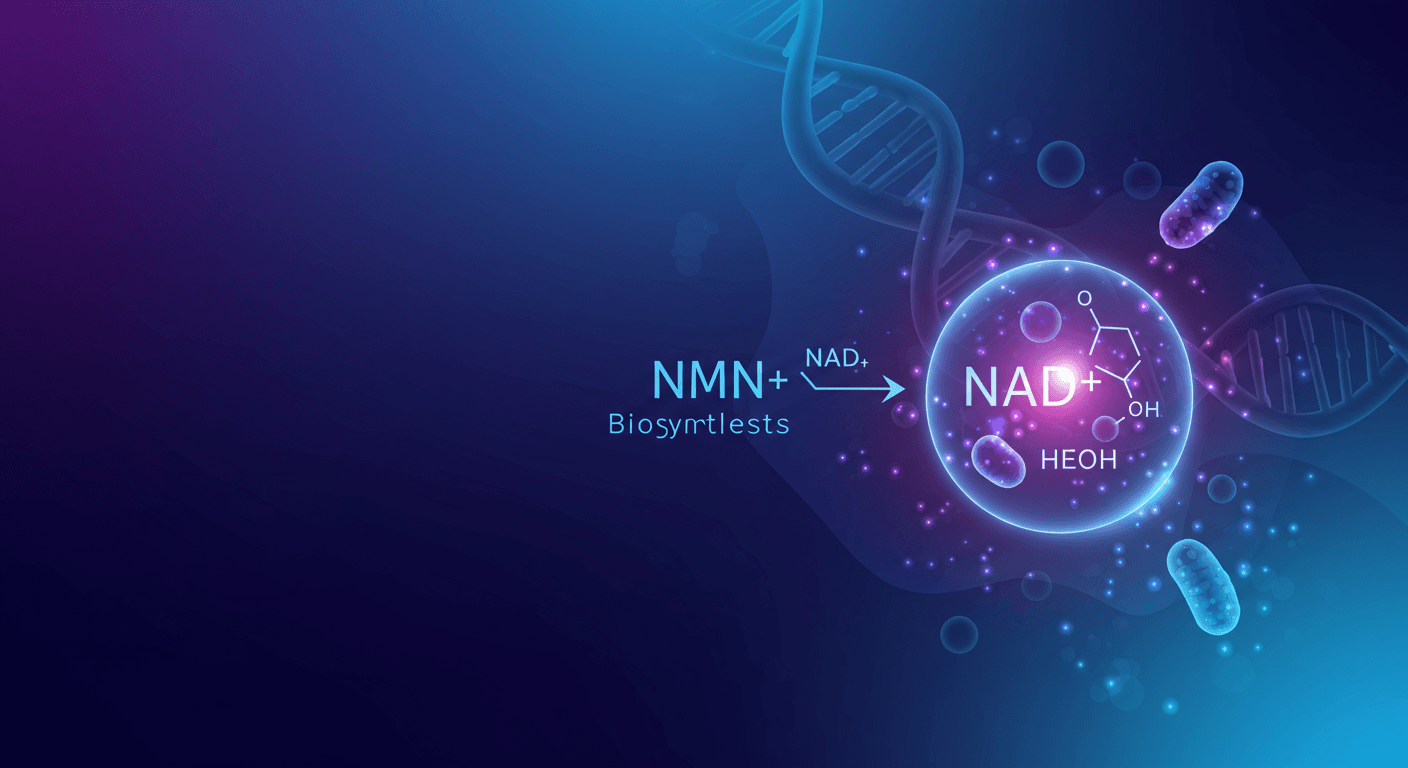
 NMN is converted directly into NAD+ inside your cells, bypassing the usual bottleneck in NAD+ production.


 Multiple clinical trials confirm that NMN reliably raises NAD+ levels — but downstream health effects vary.
 Across all human trials, NMN has shown an exceptionally clean safety profile with zero serious adverse events.
 NMN's effects extend beyond energy — emerging data points to benefits for sleep, liver enzymes, and arterial health.
 Dosage guidance should be based on your age and goals, starting low and adjusting based on response.